Turf Marking

All original material, except otherwise explicitly stated, is under this:
Creative Commons License
MMIII-MMVII
Warm Fuzzy Freudian Slippers, Ltd.
*Other People's Blogs

FYI

Things you need to know:
  • Some posts, or the links they contain, are NSFW. This is your only warning.
  • This blog serves the cause of my freedom of speech, not yours. I wield censorship like a 10 year-old boy who just found his father's handgun.
Powered By Blogger

Categories

Showing posts with label reading. Show all posts

Saturday, October 06, 2007

Again, E and I headed to the first weekend of the twice-yearly Friends of the Library Book Sale. It was one of the worst lines I've ever had to stand in at all. We stood around longer than an old Soviet Union toilet-paper line, for pete's sake.

Supposedly, the local fire marshall didn't like the way people were crammed into the old warehouse, so he laid down the law and decreed that only so many people were allowed into that giant tinderbox at a time, which meant an unprecedented hour-long line.

Still, I had an agenda, and the fact that I got that second book in the pile there made it all worth while!


I thinks it's indicitive of the refinement of my reading tastes that the piles are getting smaller. I'm just not picking up every damn book I come across. That's good, because I'm spending less, overall. Well, not really--there'll always be stuff I want, but at least I'll eventually spend less on the classics.

Saturday, May 05, 2007

Today was also Free Comic Book Day and if your local comic store was anything like my local store, then there were probably some sweet deals on stuff.

Me, I scored these...

frazy.comfrazy.com
powered by frazy.com
One of the pitfalls of steady income is the ability to go to the first and most expensive weekend of the twice-yearly Friends of the Library Book Sale. While E and I spent more on this booksale than the two previous ones we went to combined, we still made out like bandits.


My haul alone was easily worth every penny of the $40 I spent for it...


So don't be surprised if I'm not blogging again for awhile.

Wednesday, February 28, 2007

...that's just what I did last weekend.

everfree signing

That's this book, and yes, that's Carl's boy

I couldn't go the whole month of February without a blogging little sumpin' sumpin'. More next month, between the busy-ness.

Sunday, January 28, 2007

Two weeks behind again. You can partially chalk it up to the pain killers I'm on. So, here it is, sans Nick Hornby-style commentary.
  • Juan José Millás, "Other Persons"
  • Jenny Hollowell, "A History of Everything, Including You"
  • Peter Orner, "The Raft"
  • Teolinda Gersão, "The Red Fox Fur Coat"
  • Ronald F. Currie, Jr., "Loving the Dead"
  • Tobias Wolff, "Powder"
  • Susanna Clarke, "The Duke of Wellington Misplaces His Horse"
All these except for Clarke's story are in the NEW SUDDEN FICTION collection, which I highly recommed.

Sunday, January 14, 2007

Okay, the good news is that I'm more or less back on track with my reading list. The bad news is I still didn't have a lot of time to digest enough to comment on them, Hornby style. But I can at least tell you that I've read...
  • David R. Bunch, "The Escaping"
  • James Cross, "The Doll-House"
  • Jonathan Lethem, "Planet Big Zero"
  • Carol Emshwiller, "Sex and/or Mr. Morrison"
  • Me, "Code of Conduct"
  • Damon Knight, "Shall the Dust Praise Thee"
I will take a moment to mention that all save the third and fifth pieces were from DANGEROUS VISIONS and that Damon Knight's story, the shortest one I've read thus far (I think...I haven't counted pages) is a standard for genre flash fiction for me, as far as I'm concerned. This is of particular importance now, not just for the obvious reason, but because I'm working my way through PIECES FOR THE LEFT HAND as well as the recently released NEW SUDDEN FICTION.

PASSAGE OF THE WEEK
Were we viable? Did we have to convince others, or was it enough just to convince ourselves?

The question was made immediate by our careers as students. Did it matter that you were smarter than your English teacher if she could fail you for cutting class to smoke pot in the park?

-Jonathan Lethem, "Planet Big Zero"
Next week: A Susanna Clarke piece. In fact, I think I'll do a reversal--one genre piece, more mainstream with the rest.

Saturday, January 13, 2007

Sorry for the delays. The Interhighway here seems to be littered with orange barrels, just like Ohio. Anyway, two weeks ago, I read...
  • Poul Anderson, "Eutopia"
  • David R. Bunch, "Incident at Moderan"
  • Neil Gaiman, "How to Talk to Girls at Parties"
Unfortunately, it's been too long now so I can't provide anything in the way of commentary. I liked 'em--I can definitely say that.

Saturday, January 06, 2007

The darn holidays finally caught up with me, so I can't offer any words of insight into what I read two weeks ago, a la Nick Hornby's playbook. Yeah, yeah, priorities and all that, but here's my token effort anyway. The least I can do is a list...
  • Joe L. Hensley, "Lord Randy, My Son"
  • Robert Reed, "Pills Forever"
  • Raymond Carver, "After the Denim"
Next time: What I read last week...I think I've got some words set aside somewhere.

Wednesday, December 27, 2006

You thought because of the holidays, I was too busy to rip off Nick Hornby's playbook. You were wrong (though I didn't think I was going to post this before today). Last week, I read...
  • Fritz Lieber, "Gonna Roll the Bones"
  • Robert J. Sawyer, "Biding Time"
  • J. Robert Lennon, "Dead Roads," "Election," "The Current Event," "Claim," "Opening," "Copycats," "Town Life," "Rivalry," "Get Over It," "Composure," "Silence," "The Pipeline," and "Leaves"
  • Susanna Clarke, "John Uskglass and the Cumbrian Charcoal Burner"
  • M. Rickert, "The Christmas Witch"
I just had to read something seasonal but I viewed the title "The Christmas Witch" with the same trepidation as last year's DOCTOR WHO special "The Christmas Invasion." Of course, I liked WHO better, but this story wasn't so bad. Not at all what the title or even the cover of the issue of F&SF it came in would imply. It was an engaging novelette but stories that try to keep you ostensibly guessing tend to wear me out. The ones that tell you such and such a character or situation is supernatural...possibly. I liked another tale from that issue much better, Susanna Clarke's "John Uskglass..." and I know next to nothing about her JONATHAN STRANGE AND MR. NORRELL. It's definitely on my reading list for 2007--yes, 2007: The Year I Go Back to Reading Novels...Maybe.

The more I read from the SLIPSTREAM anthology, the less of it I like. I can't argue with the plot and pacing Sawyer's "Biding Time." It's a short, easy-to-follow detective story, solved by the end whereupon the bad guy is on his way to getting his just desserts. Only, I found that I couldn't care less about any of it. I never doubted for an instant that the detective would succeed.

I have to read more Fritz Leiber because "Gonna Roll the Bones" rocked. Like everything else in DANGEROUS VISIONS, there's so much more to it than the typical "gambling with the Devil/Death/Boogeyman" storyline. I'm definitely giving it a second read sometime soon.

I mentioned before that I purchased the collection PIECES FOR THE LEFT HAND by J. Robert Lennon. The thing was imported from the UK since it hasn't been published in the U.S. of A. as of yet. The bookstore wanted a little more for it and rightly so. Luckily, I chose to buy it on the day the store was giving a 10% discount off of any book with five or more words in the title. I would've (reluctantly) paid full price, so you know...gift horses and all that. And, it's certainly been a gift. --waitaminute, I guess I almost did pay full price, damn New York sales taxes! Doesn't matter. Needless to say I've been enthralled by the pieces I've read so far. A lot of them could provide endless fodder for the debate on whether short-shorts are too short to be short stories. From the first section, I'd say Lennon succeeds more often than not. Plus, well, I live in the same area he does so a lot of his "anecdotes" from the "Town & Country" section absolutely resonated.

PASSAGE OF THE WEEK
As Joe lowered hs gaze all the way and looked directly down, his eyes barely over the table, he got the crazy notion that it went down all the way through the world, so that the diamonds were the stars on the other side, visible despite the sunlight there...and so that if a cleaned-out gambler, dizzy with defeat, toppled forward into it, he'd fall forever, toward the bottommost bottom, be it Hell or some black galaxy.

-Fritz Leiber, "Gonna Roll the Bones"
Next Week: Now, where'd I put that Cheever collection...?

Saturday, December 16, 2006

I re-read through Nick Hornby's playbook more thoroughly, so as to more thoroughly rip it off. Last week, I read:
  • Raymond Carver, "I Could See the Smallest Things"
  • Raymond Carver, "Sacks"
  • Raymond Carver, "The Bath"
  • Raymond Carver, "Tell the Women We're Going"
  • Larry Niven, "The Jigsaw Man"
All those stories came out of two books: Carver's collection WHAT WE TALK ABOUT WHEN WE TALK ABOUT LOVE and Ellison's DANGEROUS VISIONS. I said last week that I was in a Carver mood. I wasn't so far gone that I delved too deeply into some Bukowski, though. No, Carver's stuff provided fit last week's malaise just right, I think. Sometimes, I think I take to Carver's stories the same way early teen emo-goth girls take to Sylvia Plaith. I think I can relate to the pain of some of the characters, though not necessarily the characters themselves: The wife caught in her grim reality ("I Could See..."), the son who sees conveniently past his own sins to look down his nose at his deadbeat dad ("Sacks"), or the husband and wife who forgets about obligations when more important things come up ("The Bath").

I confess that I read "Tell the Women We're Going" earlier this year as part of the SHORT CUTS collection. (I still haven't gotten around to seeing the movie.) I understand the lives of the characters in what is, hands-down, my favorite Carver story. The ending that I didn't see coming is what blew me away the first time. It really was the first example I read of a story with an ending that was "unexpected, but inevitable."

It's either coincidence, mental gymnastics on my part, or the application of universal truths scattered through all literature, no matter the genre, but the truth of the lives in Carver's stories dovetail with some writers' visions of future society, DANGEROUS or otherwise. Take a close enough look at the lives of the folks in Carver's world, hell the lives of the people around you for that matter. Think of what society has done in the past to try to escape. I'm not talking about the blatant escapism, either--vice and such. I'm talking about societal readjustment that often comes at someone's expense. Folks of a particular race. Or religion. Or sub-religion. Or sub-culture. People who might otherwise be left alone until someone decides they need to bear the burden for another group's comfort and/or security. That's what we see in "The Jigsaw Man." I won't spoil it here, but I'll leave you a quote by Niven in his afterward. He said, "It's only an accident of history that Red Cross blood banks aren't supplied by the death house."

Passage of the Week
A big moon was laid over the mountains that went around the city. It was a white moon and covered with scars. Any damn fool could imagine a face there.

-Raymond Carver, "I Could See the Smallest Things"
Next week: It's genre time again, I think. Maybe some bits from my backlog of F&SF issues.

Sunday, December 10, 2006

I admit it. This week I didn't even crack Nick Hornby's playbook open. I'm just winging it.

Last week, I read:
  • Alan Dean Foster, "Venting"
  • Isaac Szpindel, "From Gehenna"
  • Brian W. Aldiss, "The Night That All Time Broke Out"
  • Me, "The Evil of the Recidivist"
  • Howard Rodman, "The Man Who Went to the Moon--Twice"
  • Philip K. Dick, "Faith of Our Fathers
A few weeks ago, I shelled out $7.99 for a paperback anthology, SLIPSTREAMS, edited by Martin H. Greenberg & John Helfers. I was aquainted with some of the stories in the more "literary" end of the style, so I thought this would be a chance to see some things that were decidedly closer to the genre end.

The first tale I read, "Venting," was very straightforward and complete, if simple. The little I know about the main character is everything I need to. I didn't care much for "From Gehenna," but that wasn't Szpindel's fault. True, I saw the ending coming a mile away (especially with the "subtle" blurb on the back cover). But after last week's double shot of Jack the Ripper stories from DANGEROUS VISIONS by Bloch and Ellison, I was worn out.

Honestly, I'm not too thrilled about what I've read so far, but I'm only two stories in. The only reason the book interested me in the first place is because I'm interested in exploring the whole Slipstream style. Hence, the attempt that was made in "The Evil of the Recidivist." Though you could say that it failed to the extent that the story could be labeled strictly "sci-fi."

Maybe it was the week. It was hellish at work. Chalk it up to the inevitable atmosphere of an Ivy League school during finals week. That could be why "All Time Broke Out" was another one I didn't "get." Yes, I understood the plot, especially after reading the forward and afterward. But I really wasn't in the mood for a story about temporal physics gone awry.

"Went to the Moon" was my favorite of the bunch. The sci-fi element wasn't obvious until near the end, but that just goes to show how a compelling story can sometimes outweigh other considerations in the hands of a master.

"Faith of Our Fathers" is by far the most interesting "What If the Wrong Side Won the Cold War" stories I've ever read. The truth I took away from it concerns how, then and now, politics is sometimes the least of our problems.

PASSAGE OF THE WEEK
"Ugh glumph hum herm morm glug humk," the woman muttered.

Which means, roughly translated from the Old Stone, "Why the heck does this always happen to mankind just when he's on the goddam point of getting civilised again?"


-Brian Aldiss, "The Night That All Time Broke Out"
Next week: I've been in a Charles Bukowski/Raymond Carver mood this past week. It's time to indulge, I think.

Sunday, December 03, 2006

Dusting off, but not opening, choosing to go strictly by my fogged, hazy memories of Nick Hornby's playbook, I give you last week's reads.

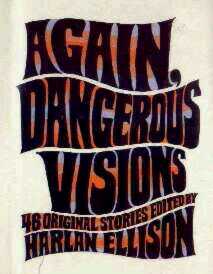
When I was with the family over the Turkey Day holiday, E and I made the trip to Half-Price Books. There are a fair amount of used bookstores in Ithaca, some that really do re-sell books at half-off. But a lot of the prices at HPB are more than half-off, which is always nice on the wallet. Aside from an audiobook copy of Robert McKee's STORY, I picked up copies of Harlan Ellison's infamous anthologies DANGEROUS VISIONS and AGAIN, DANGEROUS VISIONS. I was actually going to pick up a trade paperback copy of the former, but E suggested I pick up the hardback version with "the swanky cover," so I figured I might as well pick up the second one, too.


Anyway, everything last week came from DANGEROUS VISIONS, which I've been reading pretty much in order so far, except for having temporarily skipped the novella "Riders of the Purple Wage" by Philip José Farmer. Thus...
  • Lester del Rey, "Evensong"
  • Robert Silverberg, "Flies"
  • Frederik Pohl, "The Day After the Day the Martians Came"
  • Miriam Allen deFord, "The Malley System"
  • Robert Bloch, "A Toy for Juliette"
  • Harlan Ellison, "The Prowler in the City at the Edge of the World"
I know a lot of humanist-types who'd really get a kick out of the story "Evensong," the plot of which could be interpreted as showing the ultimate expression of the human potential. The spiritually-minded, however, could interpret that same plot as a caution of the consequences of the same.

"Flies" is undoubtedly the best human-altered-by-aliens story I've ever read, bar none. The elements are pretty shocking for something written in the sixties (which was the point of the anthology). I won't even describe them; you'll have to read it to believe it. I'd almost describe it as a horror story, but no one in the tale is as horrified as the reader.

What if, as Pohl wrote in his story's afterward (each story except for one has a forward by Ellison and an afterward by the author), sci-fi really can make all men to think of each other as brothers, "at least in the face of a very large universe which is very likely to contain creatures who are not men at all"? Don't be fooled, though. "The Day After the Day the Martians Came" doesn't convey that message directly. Rather, it clearly and succinctly illustrates the ugliness of man's often negative reactions to "the other."

It was refreshing to see a 40 year-old story written by a female (Remember: these stories were written in the 60s. You think sci-fi's dominated by males now, consider 1967.) that, in a graphic and pointed way, dealt with the "softer" sciences. This is exactly the sort of story that found the resurgence expressed in THE HARD SCI-FI RENAISSANCE. It's my favorite story of the lot, so far.

"A Toy for Juliette" was written at Ellison's behest as a sequel to a story Bloch wrote in 1943 called "Yours Truly, Jack the Ripper." Ellison then responsed with a story that picked up where Bloch left off, "The Prolwer in the City..." which is a perfect example of the sort of "conversation" that today's writers like Link or Doctorow write about (pardon me for being too lazy to Google various examples).

PASSAGE OF THE WEEK:
I offer two, having failed to add one last time. First, in this week's reading...
The city was a complex artery, the people were the blood that flowed icily through the artery. They were a gestalt with one another, forming a unified whole. it was a city shining in permanence, eternal in concept, flinging itself up in a formed and molded statement of exaltation; most modern of all modern structures, conceived as the pluperfect residence for the perfect people. The final end-result of all sociological blueprints aimed at Utopia.

-Harlan Ellison, "The Prowler in the City at the Edge of the World"
Typically, I offer these snippets without comment, but in this case I just have to note that it's a description as succinctly written as that by Garc&iactute;a-Márquez in the opening of "Big Mama's Funeral," even if the styles are different. What I mean to say is, that same magic is there.

The second is from last week's "Guy de Maupassant" by Isaac Babel, his most popular quote, in context:
I began to speak of style, of the army of words, of the army in which all kinds of weapons may come into play. No iron can stab the heart with such force as a period put just at the right place. She listened with her head down and her painted lips half open. In her hair, pressed smooth, divided by a parting and looking like patent leather, shone a dark gleam. Her legs in tight-fitting stockings, with their strong soft calves, were planted wide apart on the carpet.
Next week: More from DANGEROUS VISIONS with maybe one or two other things mixed in.

Sunday, November 26, 2006

You'll forgive me if my weekly copying/butchering of Nick Hornby's playbook is a little sparse this week with the holiday and all.

This year I'll spare all of you the sarcasm about the celebration of colonial White oppression. No rants on the great U.S. of A.'s foundations on the principles of rejected religious extremists. No, not even "Happy Thanksgiving--have a blanket!" jokes. Just last week's reads:
  • Isaac Babel, "My First Goose"
  • Orson Scott Card, "A Cross-Country Trip to Kill Richard Nixon"
  • Carrie Richerson, "...With By Good Intentions"
  • Isaac Babel, "Guy de Maupassant"
Two Book Sales ago, I got an old edition of Isaac Babel's COLLECTED STORIES. This was back when I got hooked on Raymond Carver, someone who worshipped Babel. It all seemed beyond me at first and it wasn't until I read Lessing's "Homage to Isaac Babel" last week that I had a context in which to finally open up one of Babel's story and actually get it. It's not for nothing that folks often quote "No iron can stab the heart with such force as a period put just at the right place." from Babel's "Guy de Maupassant."

Back on the skiffy/fantasy tip, I dug out another one from Card's MAPS IN A MIRROR anthology. Even a casual reader could look at the title "A Cross-Country Trip to Kill Richard Nixon" and dread the hundred-and-one different things that could go wrong with a story with that premise. Thing is that any problems the story had, IMO, didn't have much to do with the premise. Just things that seemed unlikely to me, even in a fantasy tale.

The one thing that "Nixon" and the story "...With By Good Intentions" from the Oct/Nov F&SF had in common were the simple plots and premises drawn into simple, crafted tales. One might debate whether they were good or bad--I liked them both. But I'll be damned if Card and Richerson made it look so damn easy it almost made me sick.

Next week: probably some stuff from Harlan Ellison's DANGEROUS VISIONS anthology.

Saturday, November 18, 2006

Shamelessly copying from Nick Hornby's playbook, and doing a botched job at that, I give you last week's reads:
  • Carol Emshwiller, "Killers"
  • Joyce Carol Oates, "Thanksgiving"
  • Harlan Ellison, "The Few, the Proud"
  • Jonathan Lethem, "Access Fantasy"
  • Doris Lessing, "Outside the Ministry"
  • Doris Lessing, "Homage for Isaac Babel"
I loved "Killers" from the Oct/Nov issue of F&SF. After reading it, though, I have a better understanding of the arguments of those who bemoan the fact that some stories that make their way into the mags nowadays don't have clear fantasy/sci-fi elements. You had to read between the lines of "Killer" to make out what those elements are and they're vague enough that you might be mistaken. My personal feeling is that it takes skill to do that, but that's just me.

It was the same with "Thanksgiving" by Joyce Carol Oates. I didn't plan to read it because of the upcoming holiday. It really was the next one on tap from her collection HAUNTED: TALES OF THE GROTESQUE. And it so happened that this was another story of some kind of possibly post-apocalyptic world featuring characters with all sorts of fears that seem reasonable to them, but go unexplained to us.

Needed something "manly," I read some Ellison. But I had no way of knowing what "The Few, the Proud" was about until I started reading. Sure, I guess some right-wing nut could label this story as anti-military propaganda, but the events in the tale are the sorts of things one intuits as having a ring of truth about them.

One thing I've learned about Jonathan Lethem's stories is that, IMO, you can't worry about the plot holes or you'll miss the payoff. This story is a perfect example of that. Most folks would go "WTF?" if I just tried to simply outline the plot. But then they'd end up missing the point of the protagonist's predicament, not to mention Lethem's opinions about the direction of society.

I was fed up with the Doris Lessing story I had been reading, but because I've continued to promise to read one, I went through her collection STORIES to pick out a shorter story. I read two short ones instead, the four-page "Homage for Isaac Babel" and "Outside the Ministry" which came after it. I didn't much care for the latter, between the confusing political intrigue and the fact that the story consisted of four men talking over the course of a half-hour. But the story gave me a valuable lesson on time when contrasted with "Homage," which was half the length, yet took place over the course of a week.

PASSAGE OF THE WEEK
No explanation, no context. Just the writing that grabbed me.
...and so they went down below the Undermall to the underground corridors, long echoey halls of tile, not so glamorous as upstairs, not nice at all really, the lengths apartment people went never to have to step out onto the street and see car people being really appalling sometimes.

Jonathan Lethem, "Access Fantasy"
Next week: I need me some Card and some Link, I think. And maybe something from out there on the world wide internets.

Saturday, November 11, 2006

Once again, bastardizing Nick Hornby's playbook, I give you the stuff I read last week
  • John Cheever, "The Enormous Radio"
  • Joyce Carol Oates, "Poor Bibi"
  • Cory Doctorow, "Return to Pleasure Island"
  • Alison Lurie, "Counting Sheep"
  • Kelly Link, "Some Zombie Contingency Plans"
I know what I said and I have been reading some Doris Lessing this week. I just couldn't git 'r' done, unfortunately.

I was off to a good start with Cheever's "The Enormous Radio," the first of his work that I've read (at least I can't recall if I have before). "Chekhov of the suburbs" is right. I picked it because it's referred to in a few places as an example of magical realism. It's not García-Márquez (it's not meant to be) but it does use those elements to deliver an uncomfortable truth or two.

If two weeks ago, I had the experience of finding the story I now love the most, then this week I found the story I loathe. Hey, not every story will click with folks. I know this and Alison Lurie and Joyce Carol Oates certainly understand this. "Counting Sheep" was solid, and ironically, is the story that has my Passage of the Week. But when I got to the end, I found myself asking, "Are you serious?" That's not the story I loathe, though. By the end of "Poor Bibi," I felt that I just got my chain jerked. It was a case of when you think you've figured out the ending of a story and you're given clues to indicate that you're probably wrong, but then you find out you were right all along.

I'm not 100% sure what "Pleasure Island" was about. Oh, I understood the plot (I think). And, I definitely like the way Doctorow seamlessly wove in disparate, unexplained sci-fi and fantasy elements into his story. Seriously, if I tried listing these elements separately, you'd think it was something he bogarted from Timothy Leary. But I can't say I got it on the first read. I'm not exactly sure when I'll get around to giving it a second one.

Kelly Link, as always, didn't let me down. There's nothing I can say about this story that I haven't said about her writing in general, already. Yet again, I was left with the feeling of "Why the fcuk do I bother?" One thing I will say about "Some Zombie Contingency Plans" is that the shoe that finally drops isn't necessarily the one you're expecting and I loved the way she pulled it off.

PASSAGE OF THE WEEK:
Whenever you tried to go for a walk or a picnic in the Lake District, the sheep had always got there first. Anywhere you might want to sit down, the turf had been churned by their muddy hooves and littered with their droppings, like greasy brown bunches of grapes.

-Alison Lurie, "Counting Sheep"
Next week: that freaking Lessing story already. Probably some Ellison, too.

Saturday, November 04, 2006

Again, borrowing--then crossing out lines with a black Sharpie, writing notes on the side, and adding my own rules to--Nick Hornby's playbook, I give you what I read last week.
  • Sarah Zettel, "Kinds of Strangers"
  • Jonathan Lethem, "The Dystopianist, Thinking of His Rival, Is Interrupted by a Knock on the Door"
  • Harlan Ellison, "Chatting With Anubis"
  • Neil Gaiman, "The Daughter of Owls"
  • Neil Gaiman "Shoggoth's Old Peculiar"
  • Gabriel García-Márquez, "Big Mama's Funeral"
  • Orson Scott Card, "Unaccompanied Sonata"
I hadn't heard of Sarah Zettel except through my copy of THE HARD SCI-FI RENAISSANCE. Her story was a solid example of everything that compilation stands for. It's a straightforward genre plot about a ship in deep space but the emphasis isn't so much on the science of space travel as much as the science of psychology.

"The Dystopianist" is your typical Lethem fare (that's not an insult, btw). It's a simple well-written story with one theme being, basically, about self-examination.

I got two Gaiman stories in because they were short and followed one another. I'd call "The Daughter of Owls" pleasantly grisly (Note to self: I think there's a comic adaptation of this around somewhere that I should check out). "Shoggoth's Old Peculiar," yes, refers to that Shoggoth and is set in Innsmouth. Truth be told, they were written as well as Gaiman's usual, but the stories were...well, okay.

Ellison's "Chatting With Anubis" and Card's "Unaccompanied Sonata" had some pretty straightforward plots as well. In them, the protagonists go through some pretty profound changes and not necessarily for the better. True, most like stories where a hero acts heroic and wins big. Some like the hero to lose, but still be a hero; more people can identify with a hero like that. But stories where the hero loses himself? Those stories, stories like these, can be a little harder for some people to stomach.

The story that blew me away was "Big Mama's Funeral." This is now, hands down, my favorite short story. The mechanics are nearly flawless and the language (at least insofar as the translation) is beautiful. García-Márquez's attitude toward the subject matter, i.e. his truth, isn't readily apparent until near the end, though reading it makes the last line of my choice for Passage of the Week more relevant.

PASSAGE OF THE WEEK
Now that the nation, which was shaken to its vitals, has recovered its balance; now that the bagpipers of San Jacinto, the smugglers of Guajira, the rice planters of Sinú, the prostitutes of Caucamayal, the wizards of Sierpe, the banana workers of Aracataca have folded up their tents to recover from the exhausting vigil and have regained their serenity, and the President of the Republic and his Ministers and all those who represented the public and supernatural powers on the most magnificent funeral occasion recorded in the annals of history have regained control of their estates; now that the Holy Pontiff has risen up to Heaven in body and soul; and now that it is impossible to walk around in Macondo because of the empty bottles, the cigarette butts, the gnawed bones, the cans and rags and excrement that the crowd which came to the burial left behind; now is the time to lean a stool against the front door and relate from the beginning the details of this national commotion, before the historians have a chance to get at it.

Gabriel García-Márquez, "Big Mama's Funeral"
This was only one of about five that I could've chosen. I still get shivers.

Next time: Maybe some of that Doris Lessing I promised last time and possibly a comment or two about Satrapi's PERSEPOLIS, should I decide to include comics in my weekly reading list.

Saturday, October 28, 2006

Writer Steven Barnes suggests that that you should read ten times as much as you write. Given that I should be writing every day and that I average about 2 pages (approximately 500 words) per day, and guestimating that the average short story is about 5,000 words, I've made it my business to read one piece of short fiction per day. (Non-fic doesn't count but I wonder if I should include comics.) Anyway, I've managed to do this every day for the past two weeks, religiously. What, you think I just buy all these books and never crack them open?

So, to put my money where my mouth is and make myself publically accountable, I'm modifying a page out of Nick Hornby's playbook and giving you Last Week's Reads:
  • Orson Scott Card, "In the Doghouse"
  • Gabriel García-Márquez, "Artificial Roses"
  • Alison Lurie, "The Highboy"
  • Swapna Kishore, "Reclaiming Lucy"
  • Kelly Link, "Stone Animals"
  • Harlan Ellison, "The Lingering Scent of Woodsmoke"
  • Harlan Ellison, "Go Into the Light"
Three of these stories, "Doghouse," "The Highboy," and "Go Into the Light" had plots that I believed were predictable. Actually, they were in the sense that I was able to predict the general outcome of the plot. But these writers had to know I would, so they wrote in a such a way as to me care more about the journey than the destination. But, it's a tricky business, that. Knowing where the plot was going almost turned me off each time. This is where name recognition comes in handy, though. I mean, it's Card and Ellison, for pete's sake. I might not have liked the story by the time I got to the end, but I was confident it wouldn't suck in any case being who they were, so I stuck with them.

Lurie's story I liked least of the three, but I think that's partly because the collection it's from, WOMEN AND GHOSTS (at least the edition I have) is made to look like some sort of horror thing, but it isn't. It can't be, when some of the stories had previously appeared in VOGUE, REDBOOK, and HARPER'S BAZAAR. But even for what it was, "The Highboy" was IMO a good example of what Orson Scott Card calls "the millieu story" and it made clearer to me something about the sort of changes a protagonist in a story can go through--but that's a rant for another time.

I read "Reclaiming Lucy"--a very nice, straightforward short horror piece--because I keep running into the author's name as I pore through various online mags looking for new markets. The quality of her writing (at least the two or three stories I've read so far) seems to have a consistency that I'm trying to develop. I really need to go back through and put all of the links to her stories into del.icio.us.

Link's "Stone Animals" gave me my passage of the week (see below). She can be an acquired taste, I've heard, and I can see why (although I knew I loved her stuff the moment I first read STRANGER THINGS HAPPEN). Most of her stories have a plot, no doubt. It might not be completely understandable, and it resists examination from a "big picture" point of view, but it's there. But to examine a story for the plot misses the point of some of her stuff. Her writing is beautiful. Clever, but not for its own sake. It follows, to use Alice Sebold's term in her review, dream-logic. Like a dream, Link's words make perfect sense in the moment, as you read them.

Yes, I liked Link's story this week better than "Artificial Roses" by the original master of the ethereal story. That's not to say that García-Márquez didn't blow me away, as usual. The further I get into his COLLECTED STORIES (and this could be for 101 different reasons), the more I'm able to get his stories. Granted, I'm reading translations but if they're at all accurate, then I'd say his stories are as dream-like as Link's--except his dreams are more vivid. His stories are the dreams you have that make you swear you're 100% awake.

PASSAGE OF THE WEEK
No explanation, no context. This is just the writing that stuck out to me this week.
She said, "If you don't like it, then I'll keep it. Look at you, look at those sleeves. You look like the emperor of Japan."

They had already colonized the bedroom, making it full of things that belonged to them.

-Kelly Link, "Stone Animals"
Next week: a whole new crop of stories, most likely some Jonathan Lethem and maybe some Doris Lessing.

Saturday, October 21, 2006

Not.

I got this stuff (and these are just the fiction books) last week at the Tompkins Country Friends of the Library Book Sale (N.B. I couldn't include Alison Lurie's WOMEN AND GHOSTS in the layout, here). I still hadn't gone through the backlog of last spring's books.

frazy.comfrazy.comfrazy.com
frazy.com
powered by frazy.com

So, I've decided that the only way I'm going to get through them all is a pre-planned rotation. Don't forget that I've still got these in the mix as well (including HAUNTED: TALES OF THE GROTESQUE by Joyce Carol Oates).

frazy.comfrazy.comfrazy.com
powered by frazy.com

Okay, I'm cheating--two of the books up in that last set were new. But the point is, the plan is one story per day, which is completely doable, and actually has been for the past 7 days.

Saturday, September 16, 2006

frazy.comfrazy.com
powered by frazy.com

I've finally taken the amazon.com plunge and discovered its crack-like ease of addiction. I guess there goes my devotion to local book stores(?). Anyway, it enabled my financially-challenged @ss to get two writing books that are worth a good 75% of the writing books I have so far.

Ursula K. LeGuin's STEERING THE CRAFT is a series of ten exercises on the writing craft that can be done alone or in a group. It's a book that I can always go back to (and have at the local library several times) whenever I feel like I just don't have siht.

I have no real interest in writing plays (at least for now), but when I borrowed TO BE A PLAYWRIGHT by Janet Neipris and saw some of the general writing advice she had, it was too good not to eventually buy. I can see why a lot of writers (especially comic book writers, believe it or not) are influenced by playwrights.

Go ahead, discover how easy it is, if you haven't already. You can start with my wishlist icon over to the right. You know you want to.

Tuesday, August 22, 2006

...but for me, this is what I call life, as the song goes.

Apologies in advance to those whose RSS readers I'm about to break.

1
I submitted a story to an online magazine that I usually get an average response time (read: rejected) of a month. This time around, they've held it for almost three. So I email the mag, thinking that they've rejected it and their message got caught in my spam filter, seeing as they've published the issue that I submitted the story for during their last reading period. Turns out, the tell me that they're "still considering it." I think I'll chalk this one up as the first non-rejection letter I've received, eh?

2
Currently reading:
frazy.comfrazy.comfrazy.com
powered by frazy.com

THE YEAR'S BEST FANTASY & HORROR has Chuck Palahniuk's "Guts," but that's not the reason I got it. I noticed in the table of contents a very short story by Joyce Carol Oates called "Stripping" which was included as an example of her darker fiction. I'm ashamed to say that I really didn't know she did "darker fiction."

Kelly Link's MAGIC FOR BEGINNERS was just released on paperback, so I just had to have it. I don't know why I continue to torture myself by reading her stuff. Talk about total discouragement. I read her stuff and ask myself, "Why do I even bother?"

I've been neglecting my own advice and been leafing through RUN WITH THE HUNTED: A CHARLES BUKOWSKI READER. From the parts that I've read, the editor John Martin seems to have carefully selected certain material in a way similar to the way zoos are designed to keep the patrons at a safe distance from the more vicious animals. Maybe I'll actually pick this one up soon to innoculate myself because I'm finding myself wanting to read more and more of his prose.

3
Currently Listening:
frazy.comfrazy.comfrazy.com
powered by frazy.com

Relative newcomer Christian Scott and his band blend their artistry into something accessible in REWIND THAT. In other words, it's not always about "swing" but rather "the groove," whether they're dealing with swing, R&B, or even rock grooves (see also most stuff by Lonnie Plaxico or Jacky Terrasson).

BROWNIE: THE COMPLETE EMARCY RECORDINGS OF CLIFFORD BROWN is literally a jazz master-class in a box, complete with false starts and alternate versions of songs and solos. This may sound pretentious, but that statement alone should separate those who would truly appreciate it from those who might have a casual interest but not want to invest in a 10-CD box.

There's no way I could turn my nose up at Toto's FALLING IN BETWEEN if I actually shelled out cash for CHICAGO XXX. And, not just because of the James Pankow horn arrangements, either. It's great music. Trouble is, you could level the same criticism (though some would call it praise) on Toto. One could say that someone cryogenically froze Toto back in 1989 and revived them in the studio to record this album.

4
I'm still getting adjusted to my new fall schedule at The Big Red School on the Hill. I come in later, but then I'm the last one to leave to close the Joint. There's potential in this schedule except for two things: (a) My bad nocturnal habits are creeping back in. Since last Thursday, I've gotten less than 8 hours of sleep a night, which is a long string since I've started this new sleep hygeine thing. (b) There's no longer any real time for dinner between the end of my day and any evening physical activity (in this case, yoga).

5
frazy.comfrazy.com
powered by frazy.com

I've managed to introduce The Wife to two more BBC gems that she'll enjoys, CHEF! and MONARCH OF THE GLEN. I haven't seen CHEF! in quite a few years. It's main character has all the traits I admire: arrogance, bile, the ability to hurl carefully-chosen insults, and a heart (even if he won't admit it).

MONARCH OF THE GLEN, I swear, is almost the BBC Scotland version of NORTHERN EXPOSURE, not necessarily being wacky and zany, but because of its cast of eccentric characters. Not to mention the big stag featured at the end of the opening credits, in lieu of a moose.

6
There is no...number six.

7
Now...to the grind.